




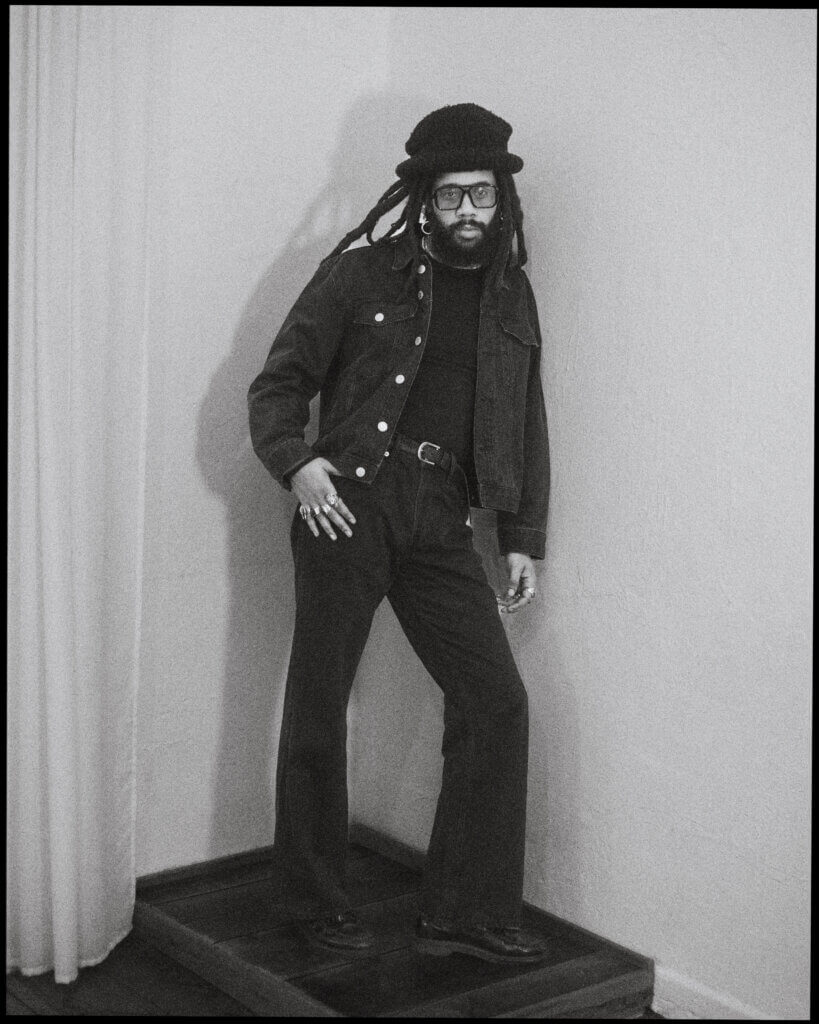
JuJu Rogers’ work moves between genres, geographies, and identities, resisting easy categorisation. Born to an American G.I. from New Orleans and a German mother, he grew up in Schweinfurt – a small Bavarian city shaped by the coexistence of US military culture and working-class German life.Those influences still run through his work today: musically, culturally, politically. Five years after his last release, he returns with Pink Guitars, Spaceships N Voodoo Dolls, a record that stretches across genres and references while staying rooted in a deeper question of identity and expression. In conversation, the artist reflects on creative evolution, ownership, and the uneasy feeling of existing in a world that seems to be constantly shifting beneath your feet. And still, there’s a quiet clarity to the way JuJu Rogers speaks, without much hesitation but often with a warm smile.
Q: Let’s go straight to Pink Guitars, Spaceships N Voodoo Dolls. What inspired your new album?
‘The old world is dying, and the new world struggles to be born: now is the time of monsters.’ That’s a quote from Antonio Gramsci. I get the feeling that the world as we know it no longer functions in the same way, and that a new world order is currently being negotiated on many different levels. In this transitional phase, truly fundamental things are being called into question. We’re living in such crazy times, politically and globally. Over the last few years, I’ve focused more intensely on one thing than anything else: staying sane. In other words, I am another person who is part of this society and these social developments, trying not to go mad and contribute something.
Q: Has the album helped you navigate the world better? To put things in order?
I don’t think it’s about order; the album is very much about accepting chaos and perhaps letting go of control. As an artist, I see myself simply as someone who documents and expresses their feelings, not as someone who stands above things and can fully explain and categorise them. I don’t have any answers; I just have lots of questions. Losing control or accepting chaos or anarchy, perhaps, also has a healing element for me
Q: Let’s take a few steps back. When did you realise that music was your thing and a way for you to express yourself?
It happened at a relatively young age, but I don’t think there was any particular moment. I was fortunate enough to start taking trumpet lessons when I was six or seven. My father is from New Orleans, the birthplace of jazz. This means that music has always played a big part in our lives and is part of our culture. At some point, the people around me started rapping and carrying recordings around on their MP3 players. It was a bit of an ‘aha’ moment to realise, ‘OK, you really can just do that.’ But I’ve always been involved in music. Whether playing the trumpet, rapping or singing in church, music has always been a part of my life.
Q: Having grown up in Schweinfurt, do you think there’s still some of that in your music today?
One thousand percent. In fact, I’d say this album captures that spirit the best. Because the city was so small, there were specific subculture hotspots where, in one night, you’d get rap, the next punk or hardcore. Because of that, the scenes mixed together and didn’t get too scattered. So I had some early exposure to hardcore and punk. Skate punk was all the rage at school. There were lots of Americans in town back then, mainly young soldiers who were usually working class too. The guys came fresh from New York, from L.A. and brought with them the culture, fashion and all that, including this raw, authentic rap sound. Plus, it was an industrial town, meaning it was very working class, and that was probably formative too. With this new album, I think I’ve managed to bring many facets of myself together – maybe not all of them, but a lot – and handle them with total confidence.
Q: There is a new sound to your new album. Do you see it as a change of style yourself?
It’s not a change of style. I’d say it’s a logical progression from what I’ve been doing for many years. My understanding of music has always been open-minded. After all, the roots of where I come from – hip-hop – are a combination of so many genres. However, I’ve realised that I find it increasingly difficult to identify with today’s hip-hop or the topics it deals with. Last year, hip-hop celebrated its 50th anniversary. As a genre, it is basically a baby. Yet somehow, over the last few years, it hasn’t managed to reinvent itself, it kind of got stagnant. Whereas the energy we’re living in right now is just much rawer, much rougher, much edgier. And that’s how I kind of slipped into these hardcore, punky psychedelic sounds.
Q: Was your approach to the album different this time around?
Definitely. I have to give a shout-out to Dhanya and Tim here [Dhanya Langer and Tim Sensbach, producers of the album]. We had many sessions creating on the spot, totally different from how we used to do things. Usually, we might have had a rough beat sketch, and then I’d sketch out some lyrics, and eventually we’d get together and record it. But this time it really came together from scratch, on both sides. This had a significant impact on the sound; there are many more live elements and it’s a bit rawer and less cerebral. We experimented a lot, and that’s when the best ideas came to us, like singing in falsetto.
Q: That rawness really comes through on the album. It makes the music feel much more immediate emotionally. Was that something you were actively aiming for?
The intention was to make it feel really raw. I’d have to think hard to come up with an instrument that we didn’t record live. It’s different from programmed beats at 90 BPM. If someone is slightly off – a bit early or late – you can hear it. You can hear all of those details in the frequency, and, luckily, in the final product too. So there’s an authenticity that I love.
Q: But you still have a ton of references and influences on the album. From sampling “Sun Ra” to sounds of Afropunk. What would you say is the common thread running through the album, if there is one?
I think it’s exploration – or breaking conventions. So “Afrophunk”, the punk element, is definitely important to the concept. And not just in relation to society, but also to me as a Black man, as a Black artist. What do I expect of myself? What conventions do people expect me to follow? I want to break them and do whatever I feel like, rather than what people expect from a hip-hop artist.
Q: That idea of breaking conventions also seems to extend beyond the music itself. You started your own label a while back. What led you to that decision?
There are many reasons, but I think it’s partly because I like being self-reliant and independent. I was also bothered by the fact that albums just sit around and don’t get promoted anymore, so I wanted to give myself a lot more agency. Then, of course, there’s also the somewhat political question of ownership. I think it’s always played a big role, particularly for People of Colour. Who owns the music? Who owns the platform? Who owns the industry? It was important to me to own my masters. So I took the plunge and brought them over to myself.
Q: Your label is called Counter Kultur. What do you mean by “counterculture”?
Counterculture to mainstream culture. Of course, there is a lot to talk about what that means right now. Well, I believe that we live in a capitalist, imperialist and white supremacist society, as bell hooks puts it. And I’m against that.
Q: But how does that work in practice? You’re still operating within the same system.
To a certain extent, definitely. But many artists probably aren’t even aware of the kind of society and social and economic order that we actually live in – who earns what, how, where, from what, and why. Only after gaining that awareness can you look at the details. Who do you work with? Who is represented? When I walk onto a set, do I see FLINTA people, People of Colour? And again, the question of ownership comes up. Where do you release your music? Could you do things yourself instead of handing everything over to big companies, or even a major label? And ultimately, in terms of content as well: What is my message? What am I putting out there? What do I want to convey?
Q: With all of that in mind, what are you working on at the moment? What does the future hold?
That brings us back to where we started. Whenever I’m not working on specific projects, I try to take life as it comes and make the best of it. I find life so intense and difficult at the moment that I’m just trying to stay human. I really do see people around me losing their humanity and becoming blind and cold. I’m just trying to avoid that. The rest will follow.