





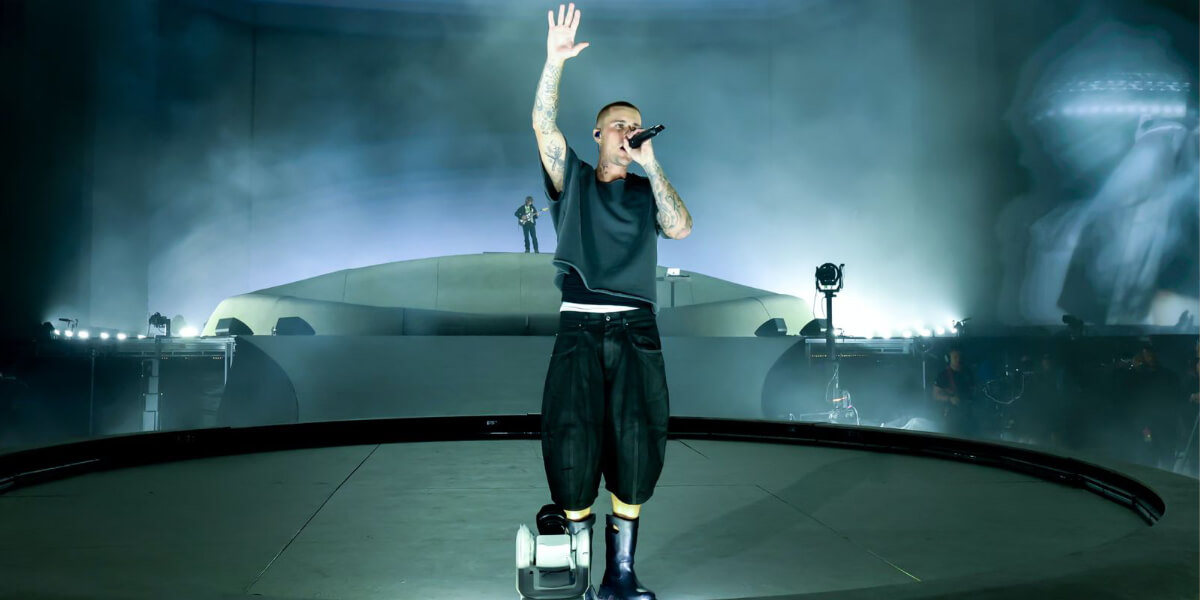
Header Image photographed by Kevin Mazur/Getty for Coachella
Return, or Reintroduction?
For Beliebers and beyond, this weekend has been circled on calendars for months. Not only because Justin Bieber was set to headline Coachella for the first time, but also because it signaled something bigger. A return to the stage.
It has been almost four years since Bieber last performed on a major stage, following the cancellation of his Justice World Tour in 2023 due to health issues.
His diagnosis with Ramsay Hunt syndrome, alongside his ongoing mental and physical health struggles due to constant public pressure, led to a withdrawal from the industry and the spotlight.
What followed wasn’t just an absence. It was the step back he needed from the version of himself that the world had known for years.
Discovered on YouTube, Justin Bieber became one of the first digital-age superstars. From early stages, he built a global fan base, sparking the “Bieber Fever” era. His fan community, the “Beliebers,” exemplifies a blueprint of modern fan culture.
Soft Launch, Loud Expectations
Earlier this year, when his name appeared on the Coachella lineup, the reaction was loud and immediate. Social media instantly flooded with throwbacks, edits, and nostalgia-heavy clips, including emotional fans eager to witness his return.
An almost instant reconstruction of peak Bieber.
At the same time, hesitation emerged. After years of absence from large-scale performances, the question was no longer just whether he would return, but how.
Even before he stepped on stage, the moment’s significance was already evident. Reports suggested that Bieber had secured a fee of around $10 million, setting him up as the highest-paid Coachella headliner to date. Expectations followed.
The narrative was already set.
Apart from still preferring an offline life, Justin Bieber surprised audiences last year with the release of SWAG, followed by SWAG II. Without a major rollout or traditional promotion, the projects felt intentionally low-key. It was almost like a quiet re-entry.
No expectations, no pressure—just new music. And somehow, Justin Bieber was back.
Legacy vs Ownership
Beyond the comeback narrative, another conversation shaped speculations. In 2023, Justin Bieber sold his music catalog, including his publishing and songwriting rights.
This shift complicates the idea of choice itself.
He continues to earn money as a performer, but he no longer has the same financial stake in the songs that defined him. Suddenly, a setlist becomes far more than just a list of songs.
Comfort, or intention?
In a culture shaped by monetization and long-term value, every decision holds significance.
Including older hits may mean prioritizing connection over profit. Giving fans what they expect. Even if the economics behind it have changed. Conversely, focusing on new material suggests something else. Control. Ownership. A forward-facing identity.
Even from the outside, it raises a bigger question that feels very current. How much of what is created is still driven by emotion, and at what point is economics allowed to take over, even if you are Justin Bieber?
The Moment Before the Moment
In the days leading up to the performance, a setlist leak began circulating online. Along with rehearsal clips, the setlist suggested a mix of older hits and new material.
And just like that, everything shifted.
Suddenly, expectations changed. What could have been a showcase of a new era started to feel like a retrospective.
The impact was immediate. Resale ticket prices reportedly climbed to around $4,000. Anticipation turned into demand. Nostalgia turned into value.
Although the show had not yet happened, people felt like they knew what to expect.
Expectation Meets Reality
The reality didn’t match the build-up.
Bieber’s 90-minute set leaned heavily into his latest releases, particularly SWAG and SWAG II. Older hits like “Baby” and “Sorry” were featured, but rarely in their original form. Instead, they appeared fragmented and layered into mash-ups or paired with archival footage.
At times, Bieber performed alongside videos of his younger self. Not just nostalgia, but something more self-aware. Almost like watching two versions of him exist at once.
Visually, the show was laid back and low-key. Hoodie, shorts, sunglasses. Minimal movement. No big choreography. No outfit changes.
No spectacle. No distraction.
His use of a laptop on stage quickly took over the conversation online. Referencing YouTube clips, interacting with digital elements, pulling his own past into the present. For some, it felt disconnected. For others, it felt intentional. A subtle callback to where everything started.
His performance was supported by guests such as The Kid LAROI, Tems, Wizkid, and Dijon, who reinforced his current sound.
Failure, or Refusal?
The response was expected, immediate, and intense.
Social media users, in particular, could not hold back. Many described the performance as low-energy and underwhelming, saying it lacked the scale expected from a Coachella headliner. Some even called it one of the worst headline performances in the festival’s history.
Meanwhile, others pushed back.
They saw someone who chose not to perform to expectations. Not to please, but to reflect who Justin Bieber is today. Less about meeting demand, more about setting a tone.
What made it so divisive wasn’t the set itself, but the gap between expectation and reality.
People expected a comeback, but instead, they got a reset.
The Anti-Performance
At a time that called for excess, Bieber opted for restraint.
Not a victory lap. Not a greatest hits show. Not even a traditional comeback.
It reads almost like a quiet refusal of what a headline show is supposed to be.
Perhaps that’s what makes the performance more interesting. Not as a success or failure, but as a position.
In an industry driven by visibility, output, and constant escalation, Bieber’s approach suggests something different. Control over scale. Authorship over approval.
Whether intentional or not, this raises a question that feels bigger than the performance itself.
What defines the value of such moments? Is it the spectacle we expect or the intention behind what we get?
What unfolded wasn’t a universally celebrated comeback but rather a deliberately restrained performance that divided opinion. It was praised for its emotional honesty. It was criticized for falling short of the scale typically expected from a Coachella headliner.
Whatever comes next, it won’t be about meeting expectations.