







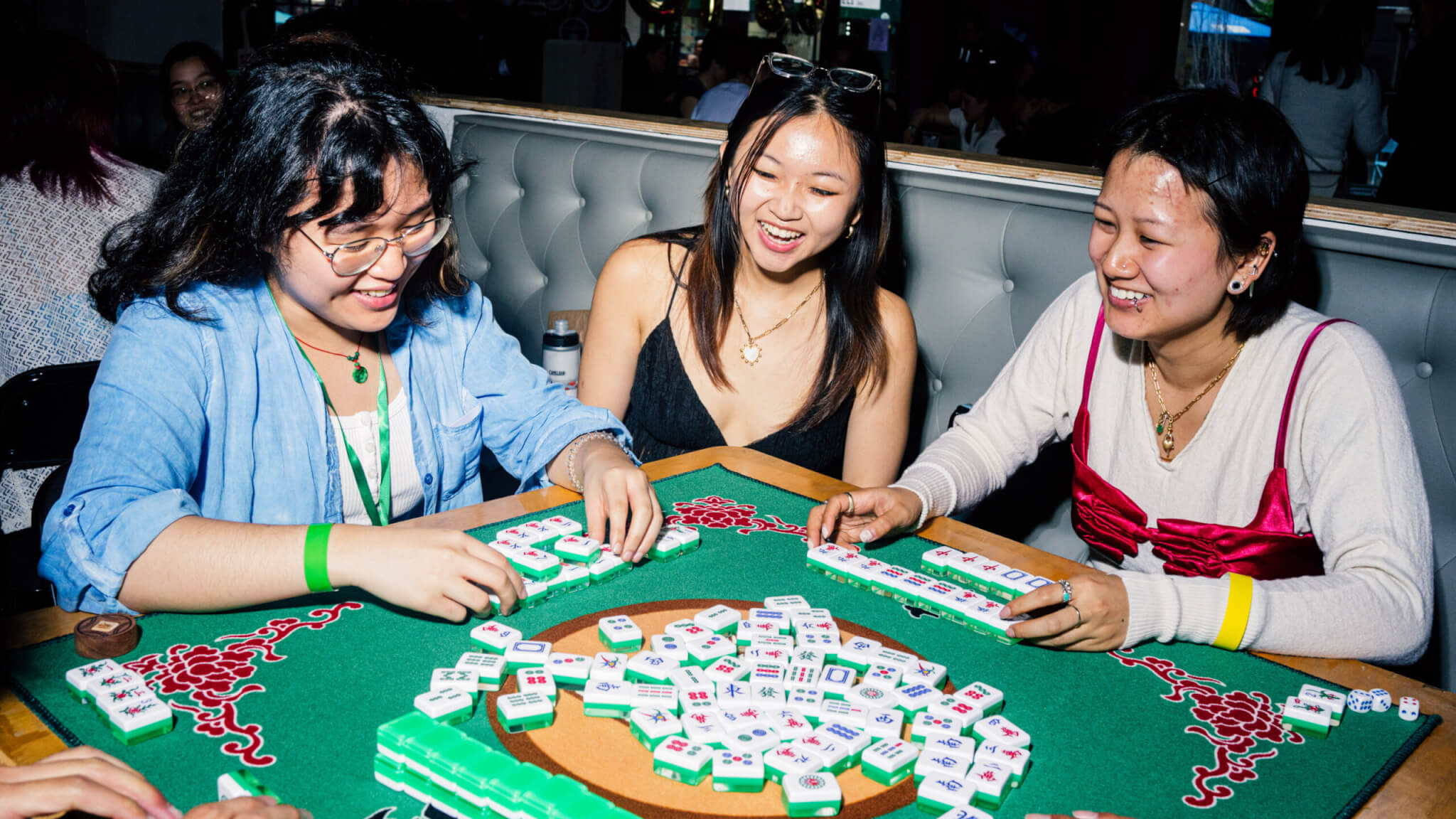
You’ve probably seen them before: white tiles with intricate circles, bamboo sticks, dragons, winds, and flowers carved into them. They come in sets of one hundred forty-four pieces and gather a group of usually four players around them. At times, one of them yells out “食糊” (Sik Wu) and flips over their row of tiles while their opponents groan in defeat. Dating back to the mid-1800s in Southern China, mahjong rose to popularity as a gambling game during a time of adversity. Now, almost two hundred years later, it’s having a major comeback. One so major that even luxury brands like Prada or Ralph Lauren have jumped onto the trend and are selling custom-designed mahjong sets “inspired by the modern glamour of penthouse living” as the latter advertise.
Just a few clicks later, I find myself looking at the “15 Best Mahjong Sets To Gift” on the Town & Country Magazine website, which calls itself a “trusted source of inside information on access and influence, taste, elegant living, and unpretentious fun”. And it doesn’t stop there. Hallmark – MAGA women’s favorite entertainment channel – just announced its upcoming movie “All’s Fair In Love And Mahjong” featuring two very white leads and, of course, an accompanying mahjong tile gift set available for purchase. The story centers on school nurse Ronni, who’s going through a difficult time and discovers she has a gift for teaching mahjong, which becomes her unexpected path back to herself and sparks a connection with Ben, a contractor fixing up her home. How did mahjong travel from the table of leftist intellectual Wu Han, who would use the clacking noises of the game to cover up political conversations, to the TV screens and tables of Texas women who play on Galentine’s Day and serve cocktails on the side?
If we take a quick look at the history of mahjong, it’s actually not the first time that it’s been so popular in the West. Entrepreneurs and tourists visiting China brought the game back to the United States in the 1920s, where it not only helped foster a sense of community among Chinese American immigrants but also became a hit with Jewish American women. They even went so far as to form the National Mah Jongg League in 1937, which established the so-called American Mahjong – a more standardized version with slightly different rules. In 2021, Kate LeGere, Annie O’Gradie and Bianca Watson – three white women who are behind the brand The Mahjong Line – decided to give the game a “respectful refresh” because they couldn’t find any sets matching their style and personality but faced backlash after putting out $300-400 sets that looked so tasteless that I feel inclined to call it cultural abomination instead of cultural appropriation.
“It never ceases to amaze how white people find new ways to colonize BIPOCs’ cultural heritage”, wrote DietPrada, a popular Instagram account calling out knockoffs and other injustices in the fashion industry. But apparently that initial call-out wasn’t enough to stop the women behind Oh My Mahjong, who were featured in a recent New York Times Real Estate story and who claim on their website that “No one is erasing history. We’re adding to it.” Well, first and foremost, they’re profiting from it. And while founder Megan is making big bucks selling her “Glitterville Mahjong Sets” and flower tablecloths, the ancient art of hand-carving mahjong tiles is slowly coming to a halt in Hong Kong.
After nearly half a century, Kung Yau Cheung Mahjong, Hong Kong’s last hand-carved mahjong store, had to permanently close its doors on March 28th, 2026, due to the pressures of urban development and changing consumer preferences. In the 1960s, there were more than 20 mahjong tile carvers in Hong Kong, but now most tiles are mass-produced in factories on the mainland. Traditionally, the pieces are fashioned from natural materials like ivory, bone, or bamboo, with tile makers cutting, polishing, carving, and coloring every single piece. “Each tile tells a story of tradition and craftsmanship that machines simply cannot replicate. When you hold a hand-carved piece, you’re touching living heritage”, says Ko Yun-Kan, one of the craft’s master artisans. Ho Sau-Mei, one of the few artisans left, and the only woman practicing the craft, has been carving mahjong tiles for over four decades, but as her eyesight is fading and her hands are getting sore, she doesn’t know how much longer she’ll be able to work. A full set takes her around two weeks to make and costs $245, which is less than half of the price that white-owned brands based in the U.S. sell their sets for.
Placed into context with the viral “Chinamaxxing” trend, it’s evident that a majority of white people have tossed everything they learned in 2020 out of the window and are back to practicing cultural appropriation confidently. Following the trend, Western social media users document their journeys to “becoming Chinese,” which, for example, includes drinking warm water, practicing tai chi, or wearing tang-style jackets. While you can’t really tell someone they’re being racist for drinking warm water, there are many layers to what we see happening over and over again in mainstream culture. bell hooks expertly peels back those layers in her essay Eating The Other: Desire and Resistance, where she writes: “The commodification of Otherness has been so successful because it is offered as a new delight, more intense, more satisfying than normal ways of doing and feeling. Within commodity culture, ethnicity becomes spice, seasoning that can liven up the dull dish that is mainstream white culture.”
This fascination with the ‘other’ goes hand in hand with the West’s ‘own crises in identity’, a crisis that the global majority has had to pay the price for for centuries. bell hooks goes on to say that, “when race and ethnicity become commodified as resources for pleasure, the culture of specific groups, as well as the bodies of individuals, can be seen as constituting an alternative playground where members of dominating races, genders, sexual practices affirm their power-over in intimate relations with the Other.” So while those white influencers might have arrived at a “very Chinese time in their lives”, they can move on whenever they feel like it, leaving with a full stomach and their teeth marks in the fabrics of a culture they’ll denigrate the second they need a scapegoat.
Still, mahjong is a game that’s meant to bring people together, and it has managed to unite and reconnect Asian Americans across all generations in the aftermath of anti-Asian hate crimes and discrimination during the Covid-19 pandemic. Writer Laura Zhang has published a great piece on her Substack where she talks to fifteen different Asian Americans in the Mahjong world about coverage, credit, and who’s cashing in. One of the most prominent communities in this new wave of Mahjong players is New York-based Green Tile Social Club, founded in 2022 by Ernest Chan, Grace Liu, Joanna Xu, and Sarah Teng – four friends who wanted to create a space for younger players and those looking to rediscover their identity. In an interview with Thrillist, Xu shares that what connected them was the desire to “deepen our roots within the existing Asian American community [in New York City] and collaborate with more cultural institutions in Chinatown. To recognize the people, entrepreneurs, community, organizers, and activists that have shaped this community.” The 200 participants showing up to each of the club’s events prove that the demand is substantial and that young Asian Americans are looking to bridge the gap between their elders and themselves by keeping mahjong alive as an integral and vibrant part of their community.
Though it’s not just in the U.S. that mahjong gatherings have gained traction. In Berlin, Mahjong Baobei hosts monthly mahjong nights, usually in collaboration with Ma-Makan, a Malaysian and Singaporean restaurant that brings together diverse communities. Mahjong Friends, currently also in Germany, is an artist collective that aims to bring more people to the game by conducting artistic research, workshops, and publications. Their book Mahjong: An International Manual explores the political metaphors of mahjong and how people who know the game, even though they might be from different regions with their own diverse rules, can find common ground when they sit together to play. It’s a space where people meet, talk, exchange, and make friends. “INVITE YOUR ENEMIES TO PLAY MAHJONG!!”, they write, and I believe that might actually be the best note to end on.