





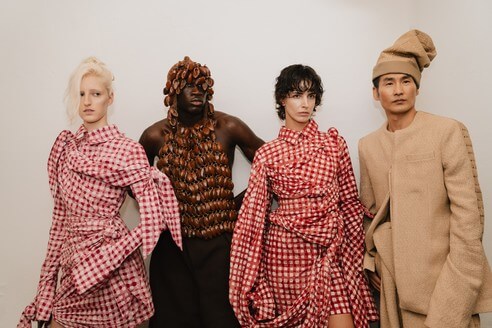
It’s Sunday morning, 10 am, and I’m still a little drowsy while waiting in line to watch Fruché’s first Berlin Fashion Week show. Founded by Frank Aghuno in Lagos, Fruché is a contemporary fashion brand, rooted in storytelling, traditional craftsmanship, and conscious design. Known for its bold and innovative silhouettes, Fruché aims to create its own definition of “African Fashion” while continuing to honor Nigerian heritage and skill. I’m basically counting sheep in my head when suddenly, the sky opens up, and it starts pouring like there’s no tomorrow. We take shelter under a row of trees, and I am once again reminded that fashion week isn’t for the weak. When we’re finally inside, and I’m fully awake, I’m drawn into a pleasant conversation with my seat neighbors, one of whom is sporting a pair of roller skates, which I find incredibly iconic.
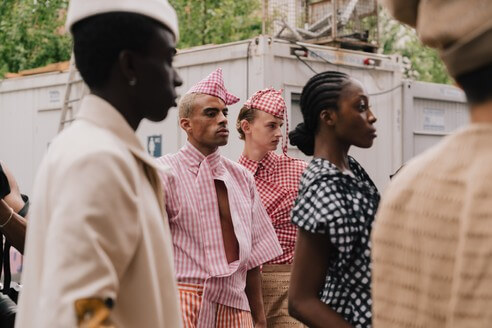
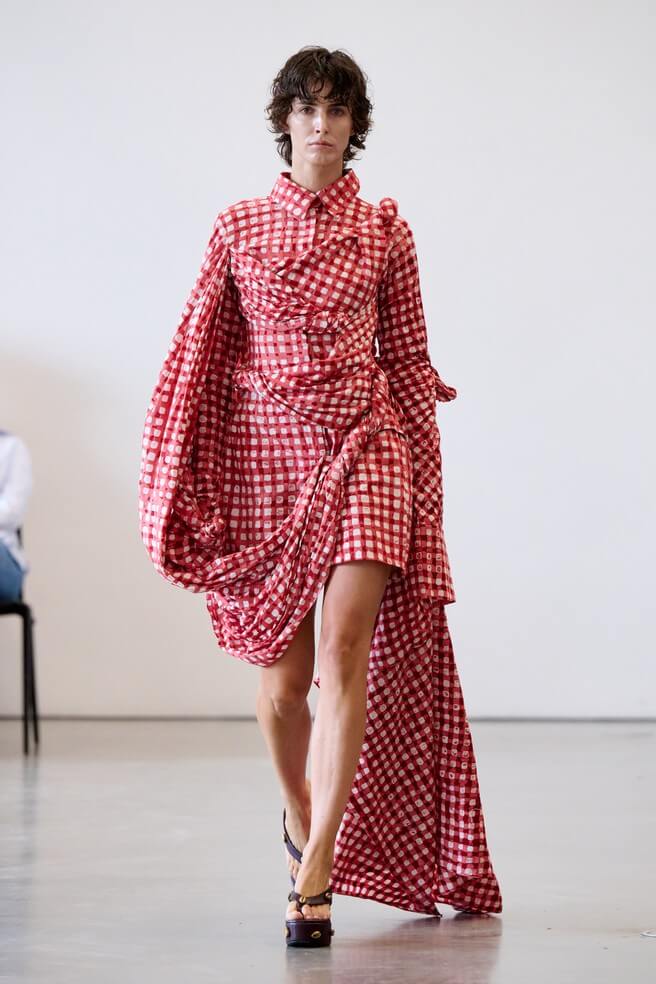
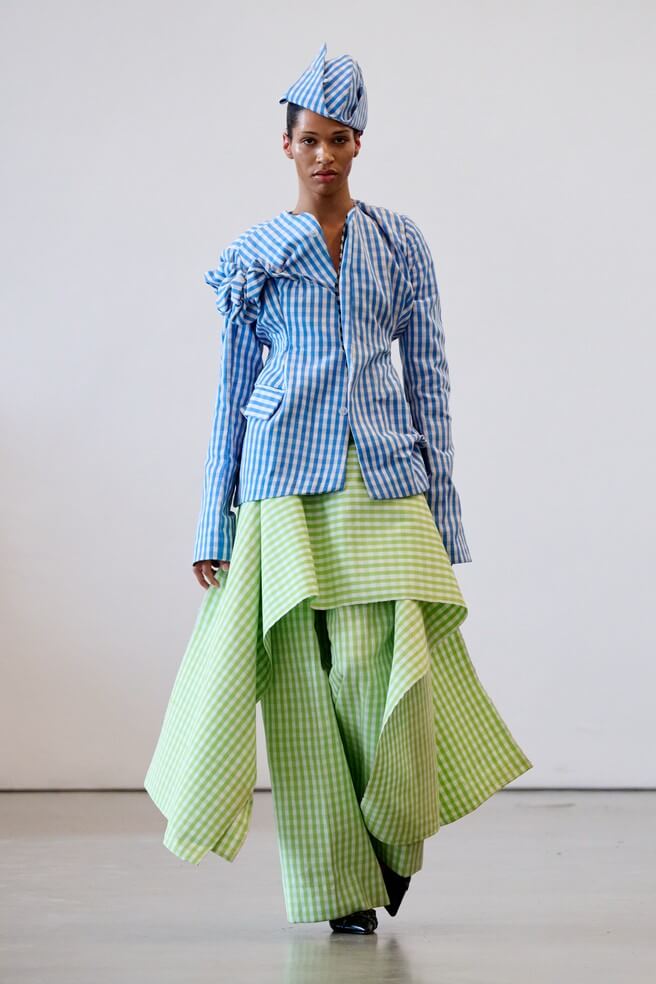
The show starts with a handful of looks made from brightly colored Gingham, one of the most common fabrics used for school uniforms across Nigeria. For Aghuno, it’s a symbol of adolescence, innocence, and a time before self-consciousness. While developing his SS27, which is named KLEG, he found himself reflecting on a time when he was least conscious of his body. K-leg is a Nigerian Pidgin term used for knock knees, but is commonly used to describe something that’s “not quite right”. KLEG takes this everyday expression and transforms it into a celebration of individuality and the imperfection that comes with being human. The silhouettes moving across the runway embrace asymmetry, distortion, and exaggerated proportions, inspired by physical features we often become preoccupied with or try to hide.
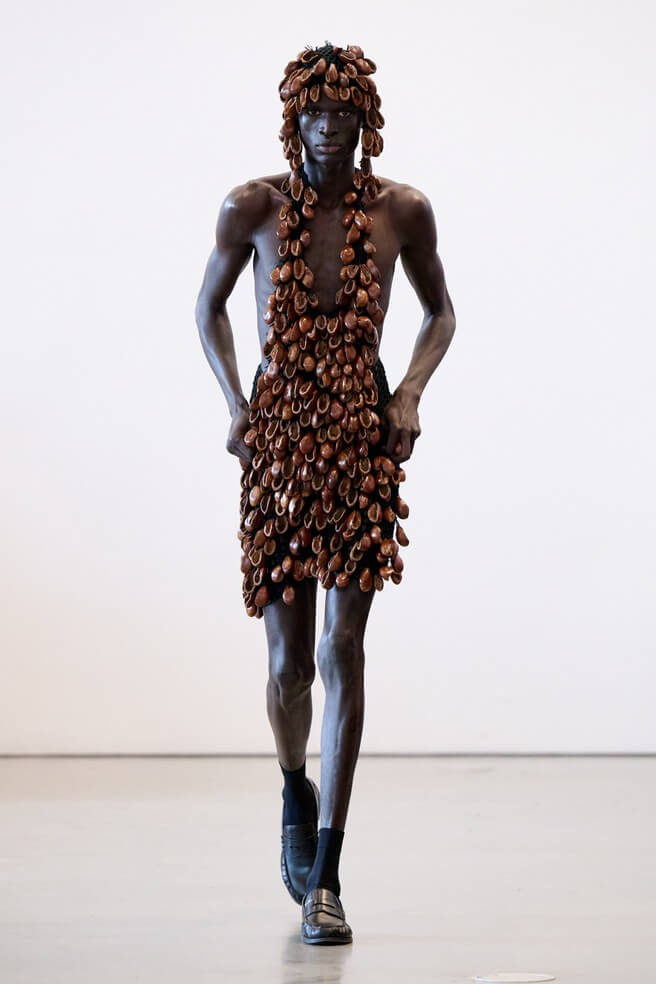
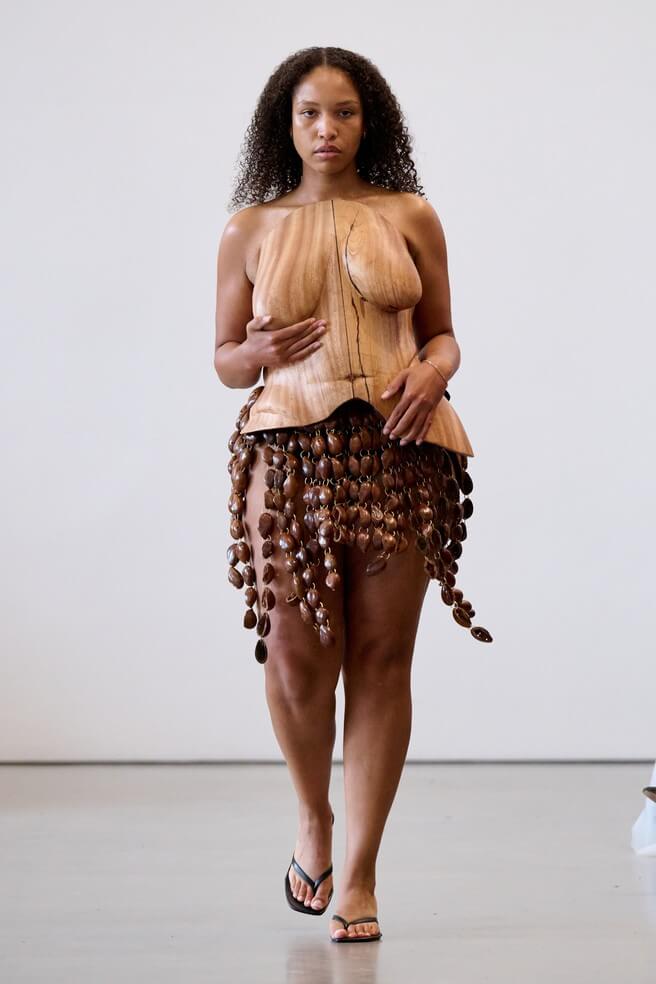
What catches my eye are the fabric origami hats created by emerging Nigerian brand Dukun. Inspired by paper boats, airplanes, or windmills, the hats bring the perfect amount of whimsy and playfulness to the collection that we’re all craving for right now. When the last model steps onto the runway, the music stops. She’s wearing a dress made completely from beads and brown dancing shells, and when she walks, the sound of the shells fills up the whole room. “She is the moment”, I whisper to my seat neighbor, and we both nod enthusiastically. After the last applause dies down, I head backstage, where I run into Orange Culture’s Adebayo Okelawal, who is just the loveliest person, and watch the after-the-show bustle until I get a quiet moment with Frank Aghuno.
This is your first time showing in Berlin. How has this experience been for you?
I’ve been having a great time. Everyone on the team has been super helpful, and I feel like people here are very welcoming. I’ve never been to Berlin before, but now I would love to be back. I haven’t really had the time to check out Berlin Fashion Week because we’ve been working up to the last minute, but the opening party was amazing, and I got to meet a lot of people from the team.
Which emotion do you associate with your SS27 collection? How do the fabrics and colors you used relate to this emotion?
This collection is about loving your body and accepting our bodies in different sizes and shapes regardless of the beauty standard. We’ve explored bodies through several techniques, like wood carving or hand-painting. It was actually my brother Dricky Stickman who hand-painted different bodies and silhouettes onto garments. I also explored Gingham, which is a fabric commonly used for school uniforms in Nigeria. Back then, we weren’t really aware of our bodies yet; we just wore our uniforms, so I wanted to shift that. We used a dyeing technique called Adire, brown dancing shells, which are worn by cultural dancers in Nigeria, and made wooden bodices. It was really interesting to explore the topic through all these different media.
You’ve been designing since the age of 11, inspired by your mother, who was a fashion designer. Can you tell me more about the role your family has played in your fashion journey?
My family has always been very supportive of my journey. My mom used to take me around to markets when I first started sourcing fabrics with 5000 naira, which is maybe two euros now. We bought scrap fabrics, and with that, I made my first collection. It was kind of terrible, but people liked it. That was in my second year of university in 2014. And then I got to show my collection at Lagos Fashion Week, which was my official debut.
What is your definition of African luxury? How do you aim to shape this definition with your brand?
I think African luxury comes from African fashion being sustainable from the get-go. Everything is slow, everything is handwoven. We know the people that produce our clothes by name, and they get paid well. African fashion is innately sustainable, ethical, and, in my opinion, already luxurious. It doesn’t have to cater to everyone, but the people that get it, get it, and they know that it’s done with love, time, and care. I think that’s what makes it luxurious.
What would you like people who wear your designs to feel?
I would love for people to feel like their best selves when they wear my clothes. I don’t think we need to pretend to be who we’re not or try to impress people we don’t really like, but just be ourselves and be comfortable with however that might look like.
What advice would you give to young designers who are still trying to find their voice and place within the industry?
Don’t listen to nay-sayers. Do what you like, and over time, you build your own identity. When I started, a lot of people turned me down, but that didn’t derail me. I did whatever I liked, and I still do whatever I like. Remember that it can be rough, but just explore and experiment. And I know that’s not easy for someone who might not come from a wealthy background, but you can still experiment in the ways that are accessible to you. You don’t have to do a twenty-piece collection; it could be just two looks, and they could be upcycled. In all my years of designing, my bestseller was a pair of upcycled jeans I originally made for myself. Suddenly, people started ordering it, and I sold like two hundred of them. So do what you can with what you have, that’s my advice.
Photographed by James Cochrane