





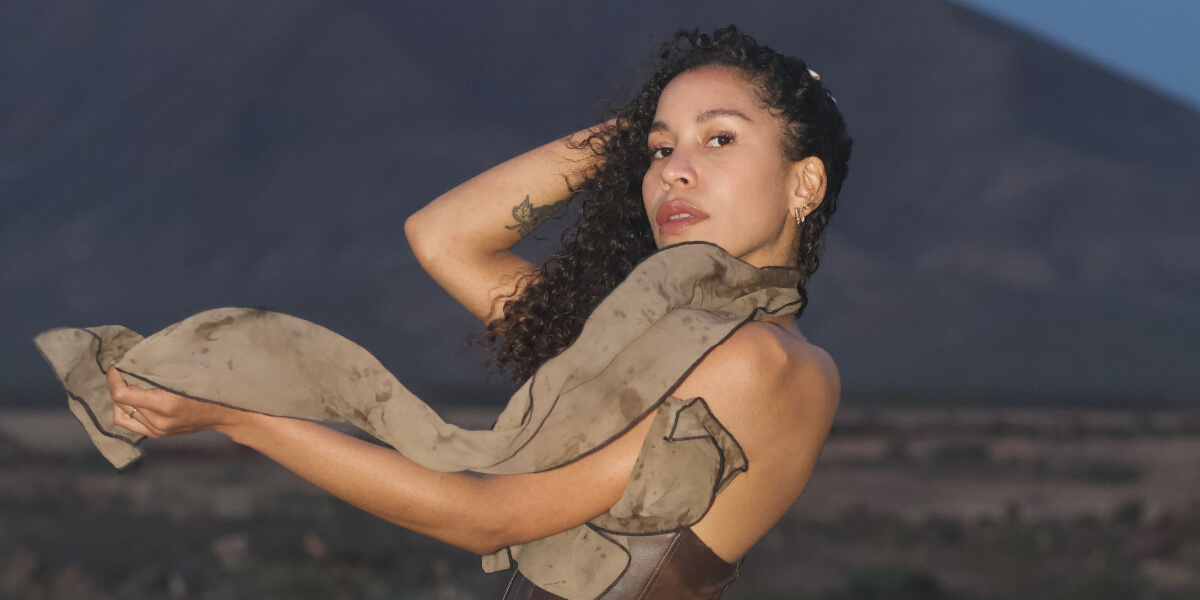
Charlotte Dos Santos has always existed between worlds—Norwegian winters and Brazilian heat, cosy jazz and fiery flamenco, quiet introspection and sweeping, cinematic arrangements. It’s in that in-between space that she’s built her career in contemporary soul. Since her debut, she’s been praised for crafting music that feels both weightless and deeply rooted. Now, after a brief pause from releasing music—and in the wake of becoming a mother—Charlotte returns with Neve Azul (“Blue Snow”), a new EP that signals a shift. Written during long, sun-drenched days in Valencia and shaped by the blue-tinted mountains of the Pyrenees, the project finds its pulse back home in Oslo, where she recorded it entirely live to analogue tape. Fittingly, it was the first snow of the season in Berlin the morning I met Charlotte via video call.
I would love to start off by talking about your new EP Neve Azul, which was recorded fully analogue, right? The process behind your previous project, Morfo, was much more digital. What made you decide to make that switch?
Morfo involved sending a lot of files back and forth online. For Neve Azul, however, I wanted a live sound and for everyone to be together in the same room. Some of the songs were started 10 years ago, so it’s ironic that now, when everything is so digital, I’m back in the studio. It’s definitely a very different experience for the listener, too, when everything is live with just instruments. I can’t quite put my finger on it, but the groove is just different, and it makes us feel different. There’s a kind of magic that goes through the humans, the instruments, and is captured directly on the tape.
Were there any challenges that you hadn’t really considered beforehand?
I suppose the challenge is that, since everything is live, if anyone makes a mistake, we have to redo the whole thing. All the instruments are recorded at once on this huge machine onto one old piece of tape. But it wasn’t really that difficult. We practiced beforehand, and then it was just like playing a concert. Usually, the first three takes are the best. It’s always really exciting to hear the difference between the demos and the live band. The instrumentalists bring their own personalities to the composition and production, making it come alive.
Was it a deliberate response to the current state of the music industry, given the rise of AI and all those glossy productions?
It’s just what I wanted to do, and what I’ve been wanting to do for a while, but it makes sense now. When everything is so hyper-digital and hyper-non-physical, I think we subconsciously miss something. It wasn’t about making a point; it was more of a natural reaction. I think this is how I will continue to work.
Before the recording comes the songwriting, tell me a bit more about that process.
I definitely think it’s therapeutic for me. But I’m not the kind of artist who gets heartbroken and goes straight to the studio to pour their heart out. I usually need some time to process it first. As an artist, sometimes you feel under pressure to write something catchy that people can relate to. But if that doesn’t come naturally, then those aren’t the songs you should write. I’ve always written songs that are just my truth, my honesty.
Has that process changed for you over the years?
I’m independent now, but I was on a big label for many years. You kind of get programmed that you have to sell a certain amount, or that you have to have a specific sound. So that’s something that I have to decolonize in my mind and find out what it is that I want to say. Interestingly, now that I have a daughter, I approach music writing from a very different place. I don’t know if this is a good or a bad thing, but I’m now aware that she’ll hear the music and know that she’s been alive. So I want it to be positive and uplifting. I’m working on a new album, due for release next year, with lots of songs about love and motherhood and things like that. In the past, I’ve always been hurt and then written about that. But now, being in a good place, it’s like, what do I write about now? How do you write a happy song about, I guess, love?
I think that is beautiful! How has being a mother and being a musician at the same time worked out for you? How do you find a good balance?
Now that my daughter is at kindergarten, I have my kind of nine-to-five. Before that, I couldn’t do music at all. I had to prioritize motherhood and put music on the back burner. To be honest, I didn’t really feel like I had a good balance. I was stressed out. I see so many working musician mums, and so many working mums in general. I really had to tell myself to relax and focus on motherhood. She’ll only be little once.
So, I suppose motherhood has influenced not only the themes of your songs, but also your entire creative process?
Yes, that’s very true. It definitely creates different moods. Before, for example, I could record at midnight while watching the moon. I loved looking at the moon while writing music. I can’t really do that now. But I will explore that again eventually.
I was also wondering how the music industry reacted. Do you think parents in music receive enough support and understanding?
There’s certainly a lot of pressure on women in the music industry. But things have changed a little. I feel like Rihanna’s Super Bowl performance showed the world that working women can be pregnant and have a family. Before that, it wasn’t something you were supposed to show. Recently, though, I’ve seen lots of musicians, my peers, starting to have families. I thought that was a really good sign.
Was that the main reason you went independent?
No, it was more that I didn’t feel understood. I very much felt they didn’t know how to place me, and we had an open discussion on that. Although it wasn’t the right place for me, I learnt a lot and gained many skills that I can use now as an independent artist. But I also just wanted full ownership. This is my life; this is what I live, breathe, and think about 24/7. You need somebody on your team who’s as passionate as you are. Of course, it’s hard to find someone like that. It’s been overwhelming, but, surprisingly, it feels so good. I definitely feel that I can anchor myself more and figure out who I am.
Speaking of identity, your EP is very much connected to your Brazilian-Norwegian heritage. How did you express that?
I’m playing more with samba rhythms, grooves, and percussion, and the project being called Neve Azul, which means blue snow in Portuguese. Snow is obviously very Norwegian, so that’s kind of a play on my dual heritage.
Can you share a bit more of what influenced the EP?
Many of the songs took shape while I was studying in Valencia a long time ago. I was surrounded by warmth, given the location — the Mediterranean. Valencia has a lot of Moorish influence; they ruled in southern Spain. So there are lots of mosaics and Arabic influences. I was travelling from Valencia to France when I saw the Pyrenees with their blue snow, which inspired the song Neve Azul.
Is there any influence on the EP that might surprise us?
Yes, I guess at the time I was listening to a lot of traditional jazz, a lot of John Coltrane. So on the song Within Me, I borrowed a little bit from his song called Naima, the melodic line on the very last phrase. And then Pale Moon, a ballad, I feel like that’s the jazziest song that I’ve done. Having studied jazz, it’s kind of paying homage to my music roots, my foundation.
Do you ever feel pigeonholed into one genre?
I think people like when I’m in the soul world, but I don’t really care so much about that. As a woman of color, I suppose you’re always going to be categorized as soul/R&B, but that’s fine by me — it’s my main influence anyway. People can interpret my music however they want and make their own connections. But I’ve always felt that I have lots of different influences.
It sounds like you don’t have any problem resisting that pressure. It seems as though you really stick to your true self. Is that your secret to success?
I suppose many people would argue that there’s a recipe for everything. There’s so much content out there telling you how to do things and which strategy to follow. I don’t think that’s all true, though. If you want people to connect with you, you have to be yourself; you have to be authentic. It’s refreshing when someone comes up with something new. I think we underestimate people all the time. Rosalía’s new album is a perfect example. She incorporates a lot of classical elements, elements that are, quote-unquote, difficult to listen to. I think we underestimate listeners or fans all the time.
Okay, just one more question about the EP. This is for anyone who hasn’t listened to the project yet, but definitely should. What’s the best way to experience Neve Azul for the first time?
Hm, maybe after dinner, you’ve already eaten, you’re just putting some candles on, and you’re about to relax… So you can be fully in the moment. It has to be already dark or at least sunset, it’s not for the brighter time of the day.