





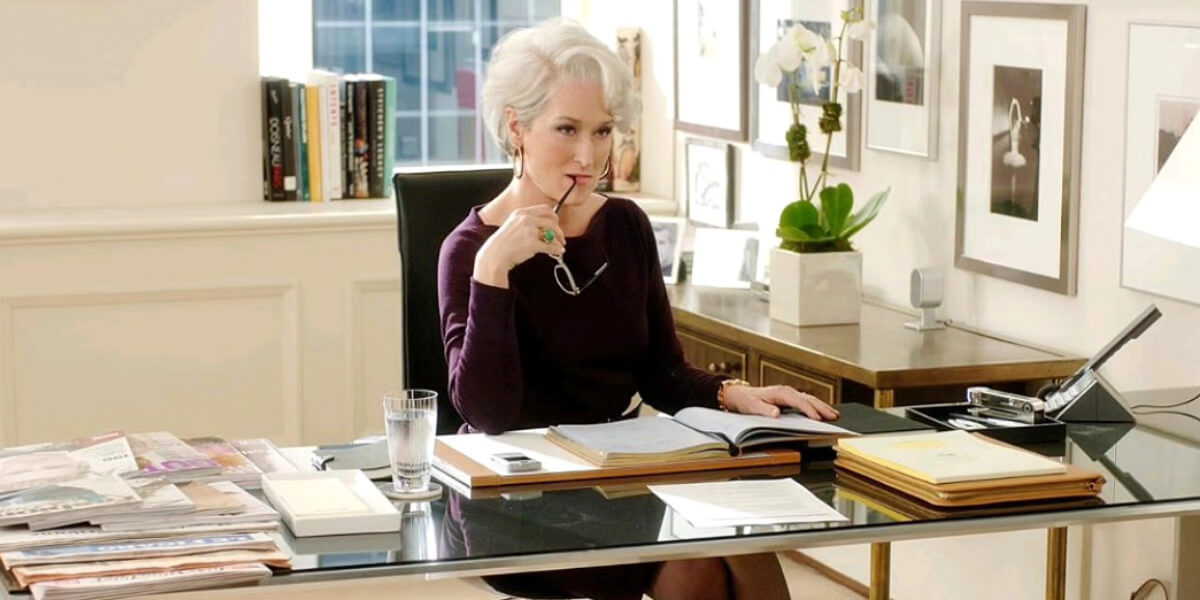
When the first The Devil Wears Prada film hit theaters in 2006, I was just about to start primary school. Fashion was still an alien concept to me; I would wear whatever my mother put out for me and most likely spill a recognizable amount of my lunch onto it. It wasn’t until a few years later that I first watched TDWP, Sex & The City, and 13 Going On 30, which awoke a strong desire to become a fashion editor with a walk-in closet in New York City. Later in life, I realized I hadn’t been the only one with that dream, but that “everyone wants this”, as Miranda Priestly tells Andy Sachs when she starts questioning her role. I also realized that I like speaking my mind and that I could no longer see myself working at a media mogul like Vogue. And it’s not just me who changed in those twenty years between TDWP and TDWP 2 – the fashion industry is in constant motion, adapting to the rapid changes of the times we live in. In this process of catching up and catering to the consumer, one that has also made fashion more democratic, it has lost a lot of the glamour and mystery that made TDWP so successful
A big upholder of this glamour used to be Anna Wintour, the former editor-in-chief of Vogue. From 1988 until last year, she’s been the face of the magazine, albeit one that’s usually hidden behind a pair of heavy black sunglasses and the 76-year-old’s signature bob. All the more surprising, when she put herself on the May cover of this year’s Vogue together with Meryl Streep, breaking the fourth wall and her former reticence to discuss the movie. In a 2009 interview with David Letterman, she subtly rolls her eyes at the mention of TDWP and replies: “I seem to remember the movie was fiction and we really like fiction at Vogue.” In the May 2026 cover story that had filmmaker Greta Gerwig sit down with Anna Wintour and Meryl Streep to talk power, fashion, and acting, Wintour now says: “I’d like to say it’s such an honour to be played by Meryl, however distant Miranda is from myself. Who wouldn’t think that that wasn’t the most extraordinary gift?” And while she’s not wrong, the whole thing gives off the energy of a haute couture level of fan service to generate more buzz about the upcoming movie. We’re still processing the disaster that was the Sex & the City spin-off, And Just Like That, that got canceled due to low ratings, as well as the painfully awkward Hannah Montana 20-year anniversary special. So the expectations for TDWP are low and high at the same time.
While most people first encountered TDWP’s film adaptation, the story is actually based on the 2003 novel by Lauren Weisberger, which spent half a year on the New York Times bestseller list. Before publishing the novel, Lauren had worked as Anna Wintour’s personal assistant at Vogue, but soon quit when she realised that what she’d gotten herself into was far from the writing job she anticipated. “This was 1999, and Anna didn’t have a computer. As her assistants, we were her computers”, Weisberger tells The Guardian in a 2024 interview. “Everyone in the office was tall and gorgeous and slender and totally obsessed with this world in a way that felt toxic to me. Every minute in that office felt like an emergency. I was just a kid. I went into survival mode.” After quitting, Weisberger enrolled in a creative writing course where she started writing a novel about what she knew, something that writing teachers often suggest. In February 2003, The Devil Wears Prada was published with a first print of 100.000 copies, and the rest is history – including Anna Wintour wearing Prada to the film’s premiere in 2006.
While Wintour is far from the devil, her carefully curated image has suffered cracks throughout the last few years. After the murder of George Floyd in 2020, which sparked global outrage and a racial reckoning throughout different industries, a spotlight was put on Vogue and its mother company, Condé Nast, where Anna Wintour holds the position of artistic director. New York Times columnist Ginia Bellafante wrote in June 2021 that “race is a fraught subject atCondé Nast.” She talked to several employees of colour who had been laid off about the challenges they faced, and not one of them felt free to speak on the record out of fear of retaliation from the company or being labeled “difficult” to work with. Bellafante adds: “Ms. Wintour has presided over Vogue for 32 years, and during that period she has done more to enshrine the values of bloodline, pedigree, and privilege than anyone in American mass media.” This statement is endorsed by Wintour’s former friend and colleague Andre Leon Talley, whose 2020 memoir The Chiffon Trenches talks about the pair’s complicated relationship. In a radio interview with Sandra Bernhard, he states: “I wanna say one thing, Dame Anna Wintour is a colonial broad; she’s a colonial dame. I do not think she will ever let anything get in the way of her white privilege.” Even though Wintour offered an official apology for Vogue’s lack of Black representation and racist undertones, the statement felt flat due to the superficiality and strange passivity with which she addressed the issue.
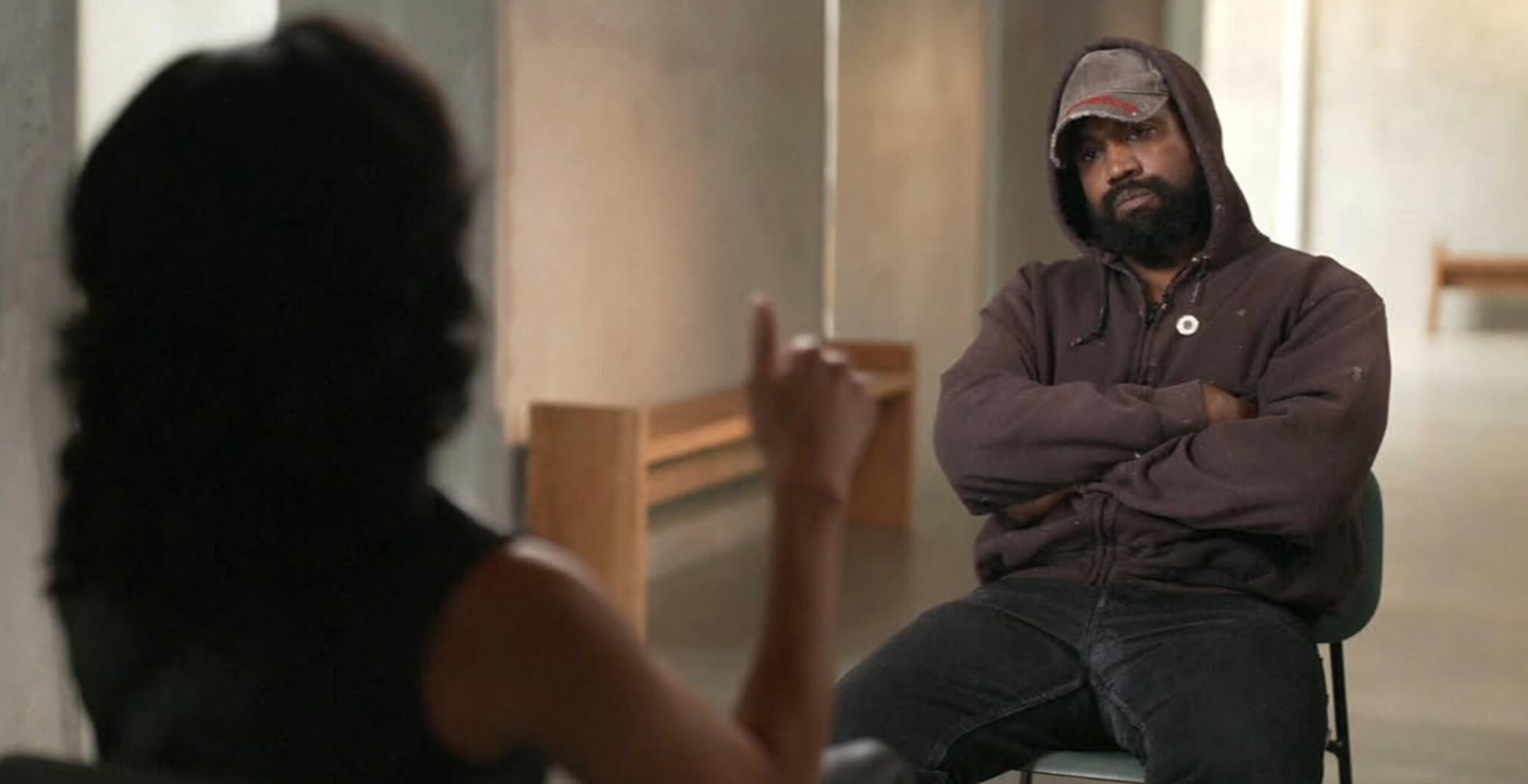
Around the same time, Anna Wintour could be seen getting all cozy next to Amazon CEO Jeff Bezos and his wife Lauren Sanchez in the front row of the Tom Ford AW20 show. A strange pairing, you think? Well, not really, because the billionaire couple was revealed as lead sponsors of this year’s Met Gala, next to secondary benefactors Saint Laurent and Conde Nast. The announcement sparked immediate online criticism, with protesters calling to boycott the Bezos Met Gala. Comments on the museum’s official Instagram range from “You had me until Bezos”, “Oh so we’re speedrunning into fascism I see”, to “Bezos won’t even sponsor his own employee’s healthcare,” or “You might as well be using AI to fake the Met Gala at this point, sellouts”. Many industry people consider Anna Wintour’s relationship with the Bezos’s as a sign of the end of an era in which Wintour had been upholding a vision of taste and exclusivity. And while many are disappointed that she would share the front row with a couple who had been sitting front and center at Trump’s inauguration, some already called the death of the Met Gala when Wintour invited Kim Kardashian and Kanye to the event in 2013. Apparently, the Gala is currently struggling to sell out tickets, forced to lower its usual price of 350 thousand dollars per table. An insider told AOL that “Vogue doesn’t control the conversation anymore. And if Vogue isn’t essential, neither is the Met Gala.” Another adds: “You paid because Anna mattered. Her approval could make careers overnight. That kind of power? It’s fading fast.”
Can the same be said about TDWP? Did it only matter because Anna mattered? How will TDWP2 address the decline of print media and its digital takeover? “So much has changed”, Wintour says in her Vogue interview. “But I like to think we’re evolving rather than disintegrating. We are still here. We’re all doing our jobs – in different ways and across multiple platforms instead of just one, but how wonderful is that? We’re reaching far more people.” According to Anne Hathaway, TDWP2 is a love letter to journalists, following Miranda Priestly and Andy Sachs as they take a last stand for print media against the rapidly changing tides of AI and monetized digital content. At the same time, the film is already facing its first backlash after online communities in East Asia called for a boycott after a promotional clip featuring a Chinese assistant character drew criticism regarding her name and stereotypical portrayal. One thing’s for sure – TDWP2 is stirring up a lot of conversation and discussion about the present and the future of fashion and publishing, one that needs to be had sooner or later.