







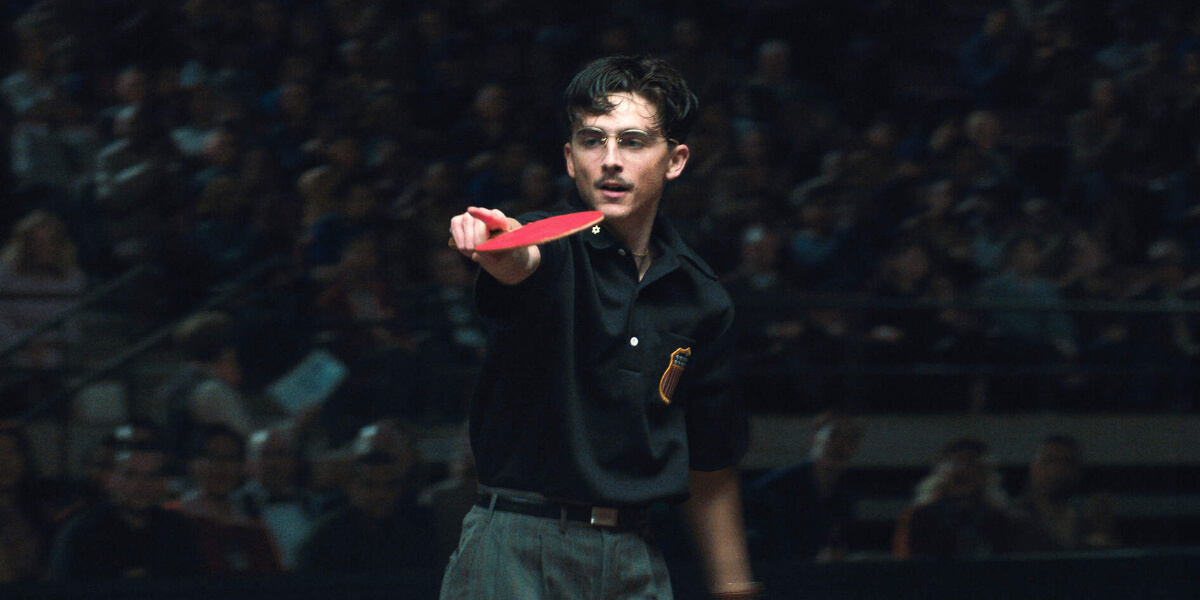
“Marty Supreme is an American film that comes out Christmas Day 2025”, Timothée Chalamet boldly shouts from the top of the Las Vegas Sphere during the promo of Josh Safdie’s newest film. Chalamet plays the titular character Marty Mauser, a young, overly ambitious table tennis player stuck in the Jewish community of 1950s New York. Working in his uncle’s shoe store, Marty wants to break out, and the upcoming table tennis world championship is his one-way ticket to fame and glory. He needs money for the plane ticket, and voilà, here we have a classic Safdie storyline: straightforward yet compelling, or rather compelling in its straightforwardness.
Over a two-and-a-half-hour runtime, we watch Marty stop at nothing to secure his shot at greatness. His escapades are haunted by a score of violins, eighties synths, and organ sounds; chaotic and thrilling in equal measure, the music easily stands out as one of the film’s greatest strengths.
Chalamet inhabits Mauser; he is transformed not just by acne-scar prosthetics, a fake monobrow, and glasses so thick his eyes look unusually beady, but also through his performance of ambition, blind confidence, and determination, traits Chalamet himself took on during the film’s extensive promo rollout.
During the promo for Marty Supreme, nothing was off the table. The promo rollout functioned as a full-on cultural spectacle, beginning with a viral, self-parodying “leaked” Zoom meeting in which Timothée Chalamet pitched outrageous marketing ideas that then materialized in real life, from the film’s bold orange visual identity to large-scale public stunts.
Highlights included Chalamet appearing atop the Las Vegas Sphere during a landmark takeover, a feature on an EsDee Kid track, limited-edition streetwear-style merch, and pop-ups that celebrities wore and circulated online, surprise fan activations tied to the film’s themes, all blurring the line between promotion and performance art, keeping Marty Supreme in constant cultural conversation. Talks about Chalamet going “method” and speculated that his new, flashy persona is actually just further promo for his role as ever-forceful Marty Mauser on-screen.
Rarely was there so much anticipation for a release, so many eyes on a single performance. In many ways, the promo became the entertainment, very emblematic of today’s fast-paced, sensationalist media landscape (as annoying as that is to say). The grandeur of the marketing then runs the risk of outshining the artistic value of the film itself.
But, the results speak for themselves: Marty Supreme has grossed over 100 million dollars (so far!), making it distributor A24’s single most successful film, and Timothée Chalamet is the front-runner to win Best Actor at the Oscars in March. This win will be deserved, especially considering his work over the last decade. Chalamet’s performance in Marty Supreme is solid, and it is evident his heart is in it—but it is not his best.
Chalamet, though himself a Jewish New Yorker, is somehow the only character not attempting the old New York accent. Even his far less experienced co-stars, Odessa A’zion and Tyler, The Creator, give it a try and deliver semi-convincing dialects. Online, some viewers have been quick to criticize this, arguing that Chalamet’s character reads like someone who “knows what Instagram is,” making it difficult to fully suspend disbelief. As a result, the lines between character and actor, film and promotional persona, blur even further. Combined with the script’s often ahistorical language, this choice is confusing: it makes Marty stand out not narratively, but tonally, raising the question of whether this was Chalamet’s own artistic decision, or part of Safdie’s direction.
Ultimately, it reinforces the sense that Marty Supreme is less concerned with coherence or period accuracy than with high-intensity entertainment — a good old-fashioned movie above all else.
Again, the Safdie formula is simple: take a self-centered anti-hero, always male, make him cause lots of trouble with reckless behavior that is continuously excused by wit and charm. This is, if nothing else, entertaining. In this way, Marty Mauser ultimately functions less as a psychologically complex character than as a condensed figure of American ambition. His blind confidence, his refusal to accept limits, and his unwavering belief in personal exceptionalism echo a distinctly postwar masculine ideal, shaped by competition, upward mobility, and the promise that greatness is not only attainable, but deserved.
Marty Supreme captures this ethos with striking effectiveness: Marty’s egotism and disregard for his environment are not questioned, but embraced as momentum. Yet it is precisely this clarity of purpose that gives the film its propagandistic quality.
As Marty represents the US on the international stage, grins next to the flag, and sings of American greatness, the narrative rarely pauses to interrogate this fantasy of American domination. Instead, it is presenting relentless self-belief as both virtue and spectacle. Exhilarating to watch, even as it leaves little room for doubt or consequence.
Beyond Daniel Lopatin’s zealous score, the film lives off its high-intensity moments. Its strongest scenes are undoubtedly Marty’s table tennis matches, which function less as the story’s center than as its narrative frame. It is here that the film taps into the electrifying, edge-of-your-seat sensation sports movies so naturally produce, a feeling most recently mastered and reimagined in Challengers (2024).
Chalamet and his costars make this feeling of pure aliveness palpable through the screen, but the viewer, oversaturated with promotional excess and the promises of blind ambition, is left exhausted. “Marty Supreme is an American film”, and it is truly, unmistakably American.