





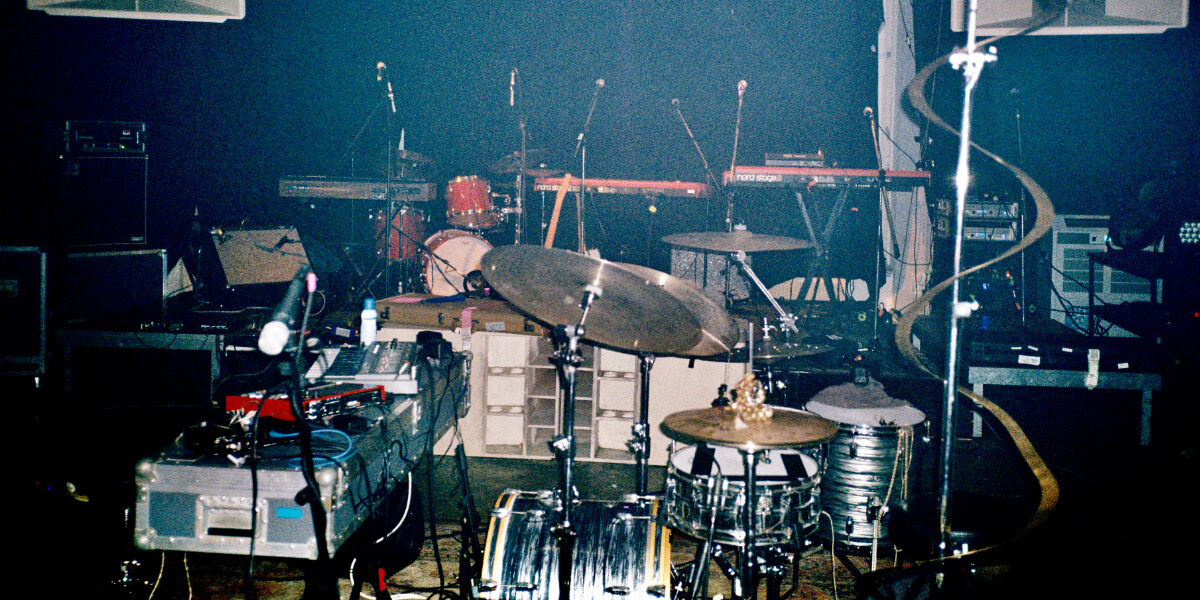
It’s the hottest day on record in Berlin, and I make my way to multidisciplinary space 90mil to celebrate the JAW family’s twentieth birthday. Berlin isn’t prepared for this kind of heat. Neither am I. Two weeks later, I sit down with the people behind it all—Maxime Libiszewski, Thomas Vermynck, and Nina Eggemann—to reflect on what happened when several hundred people willingly turned themselves into steamed dumplings while Theo Parrish tested the limits of a custom sound system.
Twenty years into its existence, JAW Family has gathered artists, friends, and devotees for a weekend-long celebration. The lineup is less a collection of names than an exercise in momentum: How do you make a jazz-leaning live act and a heavy Detroit house set feel like one continuous experience? What makes the festival especially interesting is the way it brings together scenes and formats that often exist side by side but rarely fully overlap: DJ culture, live electronic performance, jazz-influenced improvisation, and instrumental music. In Berlin, those worlds are often separated by venue logic, pacing, audience expectations, lighting, acoustics, and architecture. JAW Family was promising something more seamless—a day-to-night program where concert and club experiences merge into one fluid format. And they delivered.
Friday began with an unexpected opening: Palms Trax, better known for commanding festival-sized dancefloors, revealed his lesser-known love for folk and melancholic sounds, setting an intimate tone. Vocalist and composer Cleo Reed picked up those threads before steering the audience towards rougher, punk-infused territory, making Dumama x Abáse x Zeitgeist feel natural. As live instrumentation gradually gave way back to DJ sets, Musclecars took over before Suze Ijó and Marcellus Pittman—paired for a back-to-back set for the very first time—brought the evening to a close, all tracing the shared emotional language between different musical worlds. As live instrumentation gradually gave way back to DJ sets, Musclecars took over before Suze Ijó and Marcellus Pittman—paired for a back-to-back set for the very first time—brought the evening to a close, all tracing the shared emotional language between different musical worlds.
Saturday thrived on contrast. The heavy, groove-driven improvisations of Y-Koma featuring Noah Fürbringer dissolved somehow seamlessly into the joyful exuberance of Arp Frique & The Perpetual Singers’ ten-piece gospel-funk ensemble. From there, Red Greg and Floating Points took listeners on an all-night journey through the records and influences that underpin J.A.W’s musical universe.
By Sunday, when everyone looked a little softer around the edges, Oraculu’s immersive live set offered a gentle re-entry before the festival arrived at the weekend’s centerpiece: a musical dialogue between Berlin and Detroit through sound and centuries. Dub techno pioneer Mark Ernestus handed over the reins to Tikiman & Richard Akingbehin, with legendary Theo Parrish eventually stretching the festival’s finale into a marathon closing set. And all with a giant poster of Pharoah Sanders watching over the room while devoted dancers slowly dissolve into the temperature.
After all the preparation and intensity of the weekend, how does it feel to now look back on it?
Maxime: Honestly, I’m still reminiscing and gathering memories, coming down from it all and reflecting on how amazingly and beautifully everything turned out. We’ve been working on this for a very long time, and it somehow matched our initial vision exactly. What struck me most was the human connections and the wholesomeness of the whole event, and how everyone was in such a positive mood: the artists, the musicians, the crowd, all the staff, the crew, and the volunteers who worked with us. Everyone involved brought amazing energy and helped make this weekend what it was.
Nina: It really was like a huge birthday party, with lots of people you hadn’t met before who, by the end, had somehow become friends—or at least felt like friends. In those extreme heat conditions, barriers came down because we were all drenched in sweat. Ultimately, it turned out to be a truly special experience—something I wouldn’t have expected beforehand.
What were some of the biggest challenges in bringing this edition of the Family Reunion to life?
Maxime: Throwing a festival on the three hottest days on record in Berlin was, of course, a huge challenge. Looking back, it’s quite crazy. But people’s resilience and enjoyment kind of transformed that challenge into a memorable experience. This was especially evident on the later parts of the nights, when people were giving in to the heat and sweating on the dance floor during all of the DJ sets.
Thomas: This was also the first time we’d held a family reunion outside of an established nightclub. The first one was at Prince Charles and the second one was at Griesmühle—well-known clubs back then. People knew what to expect. This time, we had to surprise them with a place that most of them had never been to before. We didn’t know how they would react, how it would affect the atmosphere, or whether we’d manage to create that club energy later in the night. Seeing most of the DJs extend their sets and the crowd’s reaction shows that it worked out.
Can you explain a bit more how a club differs from a space like 90mil?
Thomas: Running a club is quite different from running a multidisciplinary DIY space. The door, security, gastronomy, and bar, as well as the sound techniques, are all handled a bit differently. This time we had to coordinate a big team to manage some of these aspects ourselves and have people in all the different spaces. We’ve never had such a big crew working with us before!
Nina: But it also brought us a lot more freedom and fun at the end with all the great volunteers involved. You don’t get that in a club or any typical music venue. When everything’s already there, meaning the whole infrastructure and personnel, you can only try to add your own little touch to it. 90mil gave us the freedom to set up and run their space exactly as we’d imagined it for this weekend. We are very thankful to them for this.
Thomas: On the sound side, we decided to bring a custom sound system for the DJ sets and used 90mil’s great system for the live sets. We really wanted to make the spaces work for both formats. The idea was not to change the whole space or make it ours instead of theirs, but rather to treat it as an extension. We are grateful that 90mil trusted us in making this work the way we envisioned it; together with them and Palladium Audio, the French family-run audio company that built the sound systems for the event, they did an incredible job too.
Speaking of which, J.A.W has always existed somewhere between live music and club culture. How did that relationship shape the curation of this weekend?
Thomas: We always love to bring together live music and DJ sets. It’s not easy, but I think people really cherish the experience. We are convinced that setting the mood with live music makes the party afterward feel better, or at least different. This time, we especially wanted to involve the Berlin scene and all the people we know and have supported for a long time. We’re really happy to have been able to offer them a stage at the family reunion alongside international headliners. In terms of DJs, we wanted to invite some of the people who have really made an impact on J.A.W over the past 10, 15, or 20 years.
Maxime: Having access to two separate spaces and being able to have The Box and The Shelter as two different musical worlds to curate was also a huge game-changer. The Box, whilst still quite intimate for those artists and DJs with an audience of around 400–500, had a higher energy level, whereas The Shelter was a very intimate, cozy space. The Shelter was planned to be more of an active listening space with the option to dance. It gave us the opportunity to curate more specific sets. For example, we had Red Greg play an amazing rare groove and two-step set. Musclecars started on Saturday at 3 p.m. with a set of mostly non-beat-oriented, ambient music.
What guided your choices when putting together the lineup?
Maxime: I think our curation has always been very intuitive. Even though we’d been thinking about the family reunion for about two years, most of the lineup only came together once we’d decided on the venue. Suddenly, everything fell into place.
Thomas: It kind of clicked, and we finalized the lineup within two or three weeks. Everything came together like a puzzle.
Maxime: Also, I think 90mil as a space sparked some new forms of inspiration. We have spent a lot of time there in recent years, and we have seen what they have done. Being this beloved space for artists and crowds over the years has also brought us and everyone around us a lot of new avenues, ideas, possibilities, and excitement.
Is there a particular philosophy or set of values behind the way you curate?
Maxime: It might sound cheesy, but ultimately, it’s all about creating connections. That might sound abstract at first, but we are bringing people together in the end. When you’re there, you can really see how proper human connections are created on and off the dance floor and how things grow and develop from there when you approach things with care and passion. For us, it’s also a way of acknowledging that, despite how different this music might sound on a superficial level, it’s all connected to the same roots of Black American music. This tradition is present in all these sets, live shows, and listening sessions.
A lot of what we’ve talked about so far is the artists, but the audience feels like an equally important part of the J.A.W experience. What do you think creates that particular atmosphere around your events?
Maxime: I really feel that the people at our events are very dedicated and intentional with their presence. People are really coming for the music. What I found really special was running around the venue for three days, catching glimpses of the various shows, and witnessing the dedication of the dancers and everyone involved. We invited some dance crews, and despite the heat, the energy of the dancefloors was incredible. The energy of all the dancers, whether half-professional, professional, or just music lovers having fun, was beautiful to see.
After 20 years, how has your approach changed? And what has stayed the same?
Thomas: Good question! We really try to be open and avoid repetition, even though it might be easier or more successful to stick to the same formula. However, celebrating live music and DJ culture is something we have always wanted to do, and we will keep doing it as much as we can. But obviously, the scene has changed. The economics have changed too. In recent years, we have therefore decided to do fewer parties and focus more on live music. I’m personally amazed by the amount of good music, new artists, and bands on the live music scene every year. I’ve missed this in the DJ scene a bit, to be totally fair. I feel like it’s repeating itself somehow. We see the same people on the well-known DJ festival line-ups year after year. There doesn’t seem to be much opportunity for lesser-known DJs to play bigger stages, for a broader audience.
Looking ahead, what excites you about the next chapter of JAW Family? Are we looking forward to a 25 year celebration?
Thomas: There’s a long way to go until then, and things change all the time. I’m just looking forward to the new music that we’re going to have the chance to listen to over the next few years. Seeing young artists today become big names tomorrow is exciting. I’m also curious to see what Berlin will look like then. Space is definitely an important issue for us, and I have no idea what Berlin will be like in a few years, particularly for event formats like ours.
Twenty years is a remarkable milestone, especially in a constantly changing music industry. What do you think has allowed J.A.W to maintain that longevity?
Thomas: We’ve never tried to force things, so we may be slower to some extent. If you really want to stick to the book, 20 years should have been in 2025 because we were founded in 2005. However, at that time, it didn’t feel right for us to make a move. We didn’t have the right inspiration or space. We decided to postpone it and do things properly. I think that’s the difference: we only do what feels right. If we lose that excitement, that spark, it doesn’t make sense.
Do you have a moment from the weekend that you keep coming back to?
Thomas: I will say, it feels like everyone laid the bricks that made up the pyramid, and then the final act [Theo Parrish] was at the top of it. The room was packed, and the crowd felt ready for the big finale. Nobody cared how they looked in that steamy, sweaty room—everyone gave their all. On top of that, we’ve had a special relationship with Theo for 20 years. Of all the sets we’ve experienced with him, that was one of the strongest ones for me—eight hours of pure joy. People felt it, and he felt it too. It was a very special moment of togetherness—a word I’m a bit careful about using—but I really felt it on Sunday evening.
Maxime: As promoters, it’s true that it was the one moment we were able to enjoy the most, because all the stress of the weekend was behind us. I could talk about any of the acts for ages, but that closing moment was the culmination of all the beauty of the weekend. The heat and those special circumstances, dancing covered in sweat, actually brought something almost primal to that moment. Being in the same space on a Monday morning, in this crazy heat, dancing to that music through a sound system like this without anyone wanting to stop—it was quite a special and surreal moment.