





Header image source: @ly.as @lawatchparty
Who manages to gather a herd of impeccably styled Gen Z fashion kids on a random Tuesday before 9 a.m.? To be fair, it is not just any Tuesday. It is day two of Fashion Week, and I am standing outside the Théâtre du Châtelet – one of Paris’s grandest theatres, with over 2,000 seats – where the ZOMER F/W 26 show, in collaboration with La Watch Party, is about to take place.
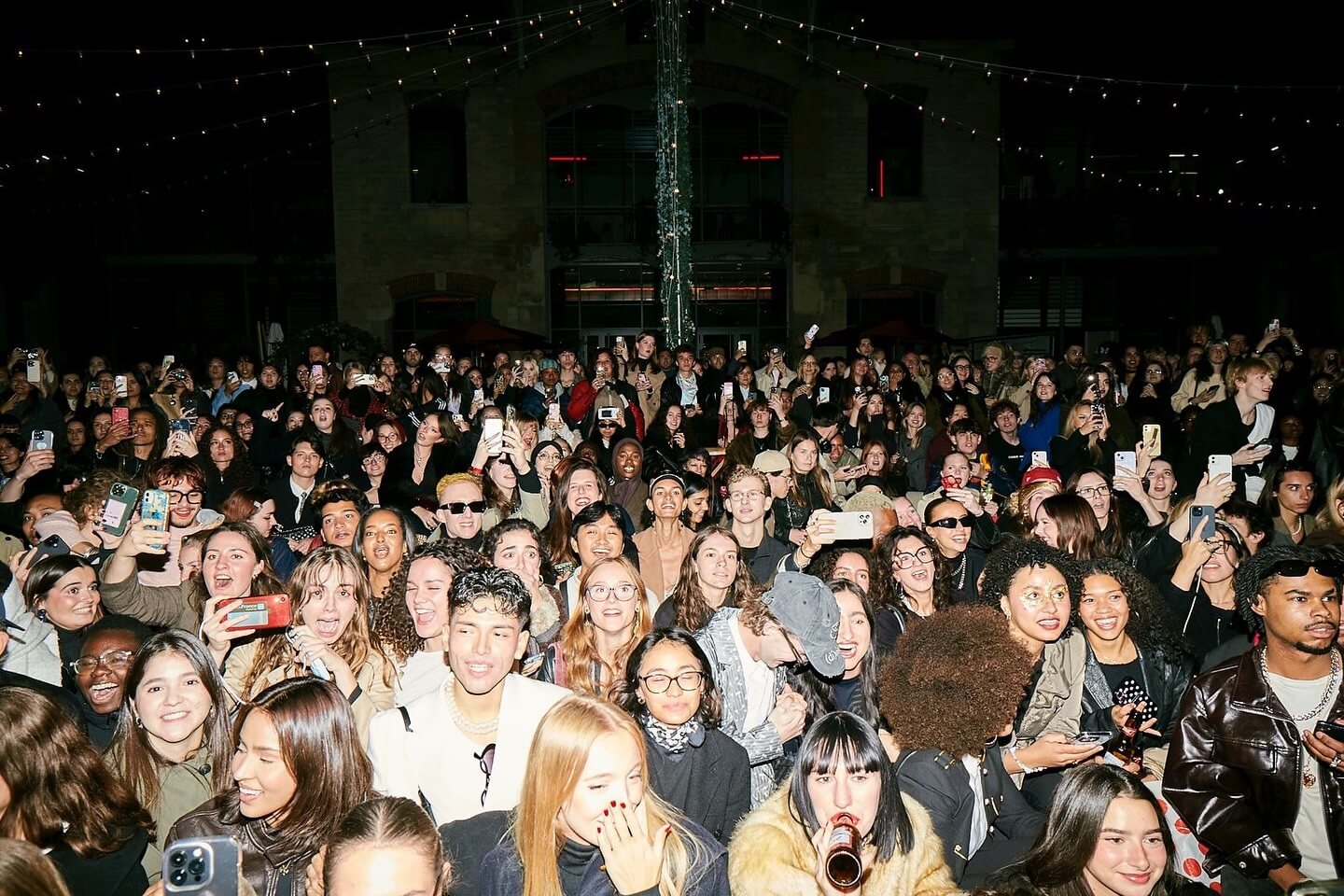
The queue stretches four people wide and is already visible from halfway down the block. Some have been waiting since eight in the morning. Many are wearing La Watch Party merch, their outfits coordinated with the kind of precision that suggests at least two hours in front of a mirror. Around me, I catch at least four different languages mid-sentence. If I didn’t know better, I could easily mistake this crowd for the line outside a very niche, very hyped pop concert.
The moment Lyas steps onto the stage, that impression does not dissolve – it intensifies. He is received like a king. The king of the fashion kids. Lyas, a 26-year-old self-described “fashion agitator,” built his following through sharp, irreverent commentary on fashion – and cemented his name by inventing new formats, none more influential than La Watch Party.
Since last June, he has organized one every Fashion Week – first only in Paris, now across Milan, London, and New York. The premise is disarmingly simple: a public viewing event for fashion shows, free and accessible to all, no RSVP required.
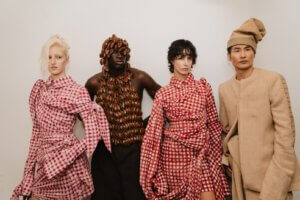
Today marks a new milestone: the first Watch Party where a show takes place live on-site. ZOMER – the womenswear label from Paris-based designer Danial Aitouganov and stylist Imruh Asha – and La Watch Party are presenting the F/W 26 collection together, right here, right now, to anyone who showed up. No invite needed. All come, all served.
Legend has it that the Watch Party was born from rejection. After Lyas was not invited to Jonathan Anderson’s debut menswear show at Dior in June 2025, he organized a public screening at his local bar in Paris within two days. His stated mission – to democratize fashion and build a bridge between the inside and outside worlds of the industry – struck a nerve immediately. The format exploded. Venues grew larger every season to hold the expanding crowd.
These days, it is rare for Lyas not to be invited. Over the past three seasons, he has been spotted at every major show – from Dior to Saint Laurent to Gucci – bouncing between the front row and backstage.
Last week, when Bottega Veneta hosted their own watch party outside their Milan show venue, and Vogue announced an exclusive – note: exclusive – watch party for the Balmain F/W 26 show in Paris, the reaction from Lyas and his community was swift and furious. In a video that circulated widely, he called out Vogue for lifting his concept without crediting or collaborating with him – and worse, for making it exclusive again. The debate that followed split opinion sharply: many rallied behind him; others turned the lens back on Lyas himself, accusing him of performing the role of the outsider while having long since crossed the threshold into the inner circle.
The tension critics identify is this: someone cannot credibly denounce elite exclusivity while simultaneously taking a seat in the front row as their audience watches on a livestream. Admittedly, there is something slightly uncomfortable about a party where the host slips away to attend the “real” event. But beneath the personal critique lies a more fundamental question: what are the actual limits of what a Watch Party can democratize? Because whatever Lyas says about elitism, the core hierarchy – who sits inside the show and who does not – remains entirely intact.
In an industry built on closed doors, unequal power dynamics, and a nepotism so normalized it barely registers anymore, the underdog story never gets old. We want to believe in the outsider who refuses to play by the rules – someone just like us, revolting against the system.
But here is the uncomfortable truth: nobody stays an underdog once they succeed. The two are mutually exclusive. The moment you make it, you become an insider – and with that comes the charge of complicity, the suspicion that you have made your peace with the very machine you once claimed to oppose. From this angle, no one can win. It calls to mind the perennial debate around rappers who “lose their credibility” the moment real money arrives. There is something to it: you cannot convincingly narrate the struggle from a gold-panelled villa draped in diamonds.
And yet, this expectation may ask for something impossible. You cannot dismantle a system from the outside. Real structural change happens from within. Think of Vivienne Westwood collecting her OBE from the Queen while going commando – punk not through refusal, but through infiltration. To me, that remains the most radical move available: get inside, then pull the architecture apart. And while Lyas does exactly that, we arrive at the question that actually matters.
But what, precisely, is being democratized here?
What makes the Watch Party so magnetic – contradictions and all – is the atmosphere it generates. The closest analogy I can think of (that Lyas obviously already played with) is a football stadium: a collective, visceral, shared experience where fans cheer, groan, and hold their breath together. Fashion becomes participatory again. At a Watch Party, there are no rules of comportment. People applaud. People boo. Enthusiasm and FUN are not just permitted – they are the whole point. Compare that to the standard fashion show, where frozen expressions, absolute silence, and studied indifference function as social currency.
More significantly, it is the discourse that gets democratized. Everyone in the community can speak – voting, commenting, challenging the traditional authority of professional fashion criticism. A space opens up where people feel genuinely entitled to have opinions about the industry, to question its structures, to push back. Because the fashion world’s exclusivity deserves scrutiny. This is an industry whose founding logic is built on scarcity and aspiration, and which continues to produce and exploit inequalities at a global scale.
The democratization of fashion cannot happen at one lever alone, and no single person or project can overturn a system this entrenched. La Watch Party may represent a symbolic form of democratization more than a structural one – but its influence is undeniable. In less than a year, the major houses are already adapting his format. That is not nothing.
Despite its logical limits, what La Watch Party does is make visible the debate we actually need to be having: is the fashion system still fit for purpose? Who has a right to participate in the fashion conversation? Lyas’s answer, in his own words: “Je pense qu’il faut donner la parole à tous. C’est ça, la démocratie : que tous aient voix au chapitre.” – Everyone should have a voice. That’s what democracy means. (Madame Figaro)
In an attention economy where community is the ultimate luxury asset, the fashion houses are being forced to reckon with community-building as a strategic imperative. Sooner or later – as we can already see with Vogue and Bottega Veneta – they will have to develop their own community formats: official watch parties, fan spaces, open-door events. The alternative is ceding access to their audiences entirely to external hosts who already hold the key.
I would argue that the underdog narrative was always, at least in part, a very shrewd piece of marketing – and one that is beginning to exhaust itself. The moment it definitively ran out of road was probably when the self-styled outsider climbed onto a mototaxi in full designer kit, in full view of his Watch Party audience, and sped off to the Dior show. Yet despite the criticism – or perhaps because of it – people still queue for hours, and the room still erupts the moment he walks onstage. Which tells you everything you need to know: this is just very good marketing, honey. And it is working.
In the end, you have to hold the ambivalence. A king of the people is still a king. He is not going to abolish the monarchy – but he might just make us feel, for a moment, like we could do it together.